

GoStudy
Author
Feb 27, 2026
Published
9 mins read
Read Time
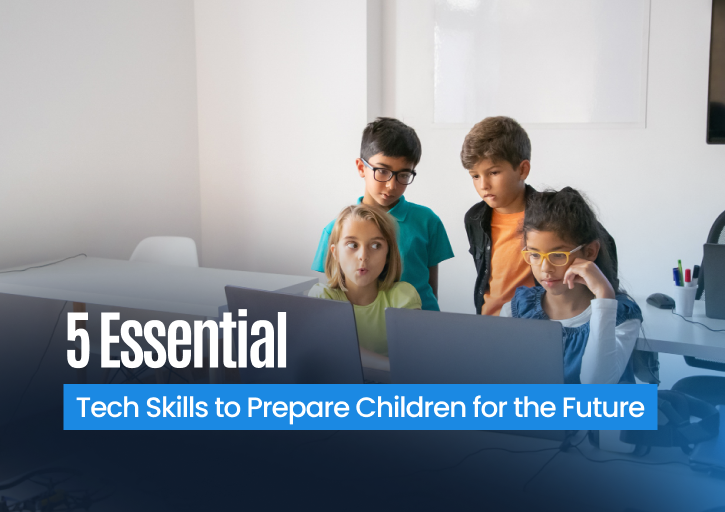
Take some time to think about this. A child in the UAE who starts school today will be working by 2040. The tools they will use, the jobs they will apply for, and the problems they will have to solve are very different from how things were even ten years ago. A lot of the parts they will play don't even exist yet.
At the heart of this conversation is technology. Not because every kid needs to be a software engineer or data scientist, but because knowing how to use technology well is quickly becoming as important as knowing how to read and write. This is particularly true in the UAE, where the national vision is based on new ideas, AI, and an economy based on information.
Below are five essential tech skills that every child in the UAE needs to develop, not as extras, but as foundations. We also explain how parents and educators can support the development of each one in practical, age-appropriate ways.
The UAE's commitment to growth via technology isn't only in its policies; you can see it in schools, in employment decisions, and in the way the country spends its money. The National AI Strategy, Dubai's Smart City initiative, and Abu Dhabi's technology clusters have all made it clear that there is a significant need for people who are comfortable dealing with technology and can think critically about it.
But the UAE's school system is adjusting to fit this new reality. Schools are adding STEM programs, coding training, and digital learning models at an ever-increasing rate. Parents and instructors who know what skills are most essential may make sure that kids are getting the deep learning they need in these areas, not just a brief peek at them.

These are the five skills that consistently come up when UAE educators, employers, and technology leaders are asked what the next generation needs most.
First, let's talk about code, which most parents already know about. But writing code isn't the only skill that matters here. What matters is computational thought, which means being able to break down big problems into smaller, more manageable steps that can be solved in a planned way.
For kids to learn this skill, they don't have to spend hours in front of a computer. Visual coding tools, such as Scratch, teach the logic of programming through drag-and-drop tasks that are more fun than work. Many schools in the UAE use Minecraft: Education Edition, which helps kids learn spatial thinking and computer logic through fun building projects. Python is generally thought to be the best programming language for older students to start with, and there are great, organised classes online for all levels.
It's not enough to know how to use a gadget to be digitally literate. Knowing where digital information comes from, how it is made, how it can be changed, and how to tell if it is accurate are all parts of digital literacy. This skill might be the most important on this list right now, since fake news spreads faster than ever, and AI-made content is becoming more and more similar to human-made content.
A child who is digitally savvy knows how to look effectively, which means they don't just type a question into a search engine and click on the first result that comes up. Instead, they use specific, well-structured queries. They know the difference between a source they can trust and one they can't. They are aware that search results are affected by algorithms that show what is popular or useful for business, not always what is true or useful. They are also starting to understand how AI tools like robots make answers and why those answers might be wrong.
These are not vague ideas from media studies. They are useful skills for getting around in the world of knowledge that every kid lives in every day.
In fact, this is the computer skill that parents worry about the most, and for good reason. Children in the UAE are online from a very young age. The risks they face range from small ones, like accidentally seeing inappropriate material, to big ones, like being hacked, having their name stolen, or being a victim of online predators.
Teaching kids about cybersecurity is more than just telling them not to share their passwords or talk to strangers online. It means really learning how cyberattacks work, like why some links are bad, how personal information can be stolen and used wrongly, what social engineering looks like, and why privacy settings are important. Kids who understand how cybersecurity works on a deeper level are much better prepared to spot and deal with threats than kids who have only been given a list of rules to follow.
This skill is also very useful in the workplace. Cybersecurity is one of the job markets in the UAE that is growing the fastest, but there aren't enough skilled people to fill the positions. A child who really enjoys and is good at this subject will have a lot of job opportunities in the future. But even people who don't want to go into this field officially will benefit greatly from knowing how to keep themselves and their businesses safe in a world that is becoming more and more digital.
It's true that we live in a "data-driven world," even though this term is used a lot. Data analysis is being used more and more to make decisions in business, government, education, healthcare, and almost every other area. You need to be able to read, understand, and draw conclusions from data quickly, becoming an important job skill in fields that are not traditionally tech-related.
To be able to use data well, kids don't need to learn complex statistics or machine learning methods. Being able to read a graph and ask good questions about what it shows and what it might not show is an important core skill. It means being aware of how numbers can be shown in ways that aren't always clear. It means being able to gather data, put it in order, and use it to come to a good decision. These are skills that kids naturally learn through math and science, but they need to be tied to the digital world they live in at all times.
In many entry-level professional jobs in the UAE, you are already expected to know how to use spreadsheets, show data in a simple way, and understand graphs and charts. Kids get a real head start when they learn how to use these tools in school instead of when they start working and suddenly have to use them.
Kids in the UAE already use AI every day in their social media posts, search results, streaming platform suggestions, and smart home devices. The vast majority of kids use AI all the time, but they don't know how it works, what its limits are, or how it changes the things they see.
Knowing what artificial intelligence is, how machine learning systems are taught, and why AI tools do the things they do (including why they sometimes get things very wrong) is called AI literacy. It also means being aware of the moral problems that AI brings up, like fairness, privacy, bias, and how to give power to people who run powerful AI systems.
A number of schools in the UAE have already started to include AI language lessons, and the Ministry of Education has said that they want to make this an important part of the national curriculum. If kids get ahead of this curve and already know how AI systems work at a basic level by the time they are taught in school, they will be in a much better situation to learn a lot quickly.
Take a step back and think about what the five skills on this list mean. You can't split them into five different things. They work together to make a set of skills that help each other at every level.
A child who knows how to use computers is better prepared to understand how AI systems work. A child who knows how to use technology well can better understand the information they find online. A child who knows a lot about hacking gets why data privacy is important on a deeper level. These skills build on each other, which means that getting good at even one of them tends to speed up progress on the others.
Parents and teachers shouldn't try to teach all five at once. Instead, they should figure out which skills their child is easily picking up and which ones need more focused attention. After that, regular, fun contact through the right platforms, projects, and talks can help build skills over time in a way that doesn't feel forced.
Because every kid is different, there is no one right age. You can start learning computational thinking and simple coding as early as 5 years old with tools that are based on games. Talking to kids about digital literacy and internet safety should begin as soon as they get their first device, which is usually around age 6 or 7.
Coding, digital skills, and STEM programs are being added to the curriculum of many schools in the UAE, especially private and foreign schools. If parents really want to make sure their kids are getting better at these things, they will probably need to add to what they are learning at school with extra tasks and tools they can do at home.
Coding is not the only important skill you need to have. The greater skill that can be used most anywhere is computational thought, which is the reasoning that code teaches for solving problems. Digital literacy, data literacy, safety knowledge, and AI literacy are all important, but data literacy and AI literacy may be more useful to most students right away.
Quality is more important than nquantity Screen time spent on coding platforms, creative digital projects, or organised learning tasks is very different from screen time spent on entertainment or passively scrolling. The UAE's health standards say that all screen time should be balanced with physical exercise and playtime away from screens, especially for younger kids.
Employers in the UAE always say that the tech skills they want most in new grads are the ones that allow them to communicate digitally, analyse data, code, and use AI tools. Problem-solving, logical thought ,and the speed with which you can learn new tools are also very important meta-skills that tech education teaches.
The world that schools are training kids for is not some impossible-to-imagine future. It's already here in a lot of ways. There is no need to prepare for a world that might exist in twenty years with these digital skills. Instead, they are skills that are already changing chances and results for young people in the UAE.
Parents and teachers shouldn't try to turn every kid into a tech expert. Instead, they should make sure that no kid grows up without the digital skills they need to get around, make a difference in the world, and change it for future generations.
These five skills, computational thinking, digital literacy, cybersecurity awareness, data literacy, and AI literacy are that foundation. They are not the ceiling of what children can achieve. They are the floor from which every other ambition becomes more reachable.
Explore UAE-curriculum-aligned tech learning resources for every age at GoStudy.ae helping UAE children build the skills that matter most.