

GoStudy
Author
Apr 4, 2026
Published
7 mins read
Read Time
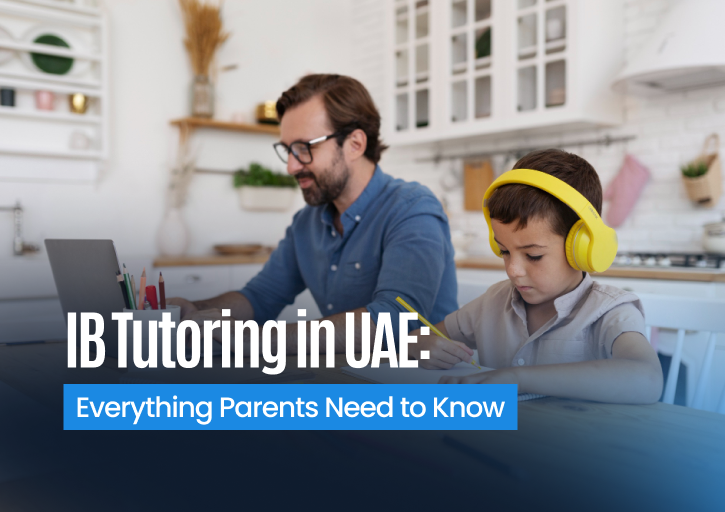
The IB Diploma catches a lot of families off guard. Not because they did not know it was demanding, but because the sheer volume of what it asks of a 16 or 17-year-old is hard to fully picture until you are living it. Six subjects at two different difficulty levels. An independent research essay of 4,000 words. A course in the philosophy of knowledge. Logged activity hours. Internal assessments in most subjects. And then, at the end of two years, a final examination series that carries enormous weight.
UAE families tend to choose IB schools because the qualification opens doors internationally and the academic standard is high. Both things are true. But the IB is genuinely hard, and a fair number of students who are completely capable of doing well find themselves struggling somewhere in the middle of it, usually because they did not have the right support in place early enough.
That is where IB tutoring comes in. This guide is for parents who want a straight answer on what IB tutoring actually involves, when to start, which subjects need it most, and what to look for when choosing a tutor in the UAE.
Students enter the IB Diploma Programme in Years 12 and 13, typically aged 16 to 19. They pick six subjects spanning different disciplines, languages, humanities, sciences, and mathematics. Three of those are studied at the higher level, and three at the standard level. That gap matters more than most students expect. Higher Level is considerably more demanding than Standard, and choosing three Higher Level subjects without a clear sense of what each one requires is one of the more common IB mistakes.
Beyond the six subjects, there are three compulsory core elements. The Extended Essay is a 4,000-word independent research piece, written on a topic of the student's choosing, assessed against a specific set of criteria. Theory of Knowledge is a course built around examining how we actually know what we think we know, with an assessed essay and presentation. Then there is CAS, which stands for Creativity, Activity, and Service, requiring students to engage meaningfully with activities outside of their academic work and write reflective accounts of those experiences.
Dubai and Abu Dhabi have some of the most competitive IB schools in the region. That is part of why families choose them. But it also means students are often working in a peer environment where the pressure to perform is constant, and where falling behind in even one subject can feel significant.
The most common situation GoStudy hears from UAE parents is this: my child is working hard, they are putting in the hours, but the grades are not reflecting it. That tends to happen because the IB rewards a particular kind of thinking that is different from what most curricula have taught students up to that point. It is not about knowing the most information.
For some students, the problem is not about any single subject at all. It is about managing the whole thing. Two years, six subjects, three core components, Internal Assessments, school deadlines, and a life outside of studying. Without a clear structure, things fall through the gaps. An IB tutor who knows how the full programme fits together can help a student build that structure, which is not something most parents can easily do if they did not go through the IB themselves.
Every IB subject can benefit from one-to-one support. But some come up more consistently than others.
Math is the one thing UAE families ask about first. There are two IB Maths courses, Analysis and Approaches and Applications and Interpretation, each offered at Standard and Higher Level. The jump from Standard to Higher is steep. Higher Level covers calculus, complex numbers, vectors, and probability in real depth, and students who did well in IGCSE Maths without fully understanding the underlying concepts often hit a wall when that depth is required. A good IB Maths tutor pinpoints exactly where the understanding is shaky and works on that before it becomes a bigger problem closer to exams.
Biology, chemistry, and physics all carry a heavy assessment load at the IB level. Each science has an Internal Assessment component that asks students to design and carry out an independent investigation, a style of work that many find unfamiliar and stressful. The final exams test both factual knowledge and the ability to apply that knowledge to data the student has never seen before. GoStudy IB science tutors are specialists in their individual subjects. They know what the examiner's mark scheme rewards, and they prepare students for both the content and the specific assessment skills the papers require.
IB English is harder than many students expect, even those who consider themselves strong writers. The Individual Oral, the written assignments, and the exam papers all require a very precise kind of analytical writing grounded in close textual reading. A student who writes well in a general sense may not be producing the kind of structured, evidence-led argument that IB English actually rewards. A tutor who knows the IB English assessment criteria works on essay structure, close reading technique, and how to meet the specific expectations of each component.
It's not enough to just know about a subject. When it comes to exams, the IB has its own set of rules for how to grade them and what a good answer should look like. It's possible for a teacher who is great at A-Level Chemistry to not know much about how IB Chemistry papers are set up or how the standards for internal assessment are used. Before hiring an IB tutor, make sure you ask them directly about their experience with the IB and not just with the topic in general.
It's also important to know how the whole IB program goes together. A good IB teacher is more than just someone who knows a lot about the subject. They know how the timeline for the Extended Essay fits in with Year 13 revision, how to help a student balance three Higher Level topics without failing on the most important ones, and how to set priorities for Internal Assessments. That knowledge of the program level is what makes real IB help different from general tutoring.
Most GoStudy IB students work with their online tutors and find it works well. People meet through video calls and use a shared digital whiteboard. Past tests, writing drafts, internal assessments, and problem sets are looked over in real time by both the student and the tutor. It is very important that the teacher can see how the student is thinking about a question, not just if the student gets the right answer. For IB preparation, that kind of visibility is really helpful in a way that it might not be for easier topics.
Families in the UAE also don't have to worry about logistics when they use online training. There is no need to drive across the city, set a time to visit the centre, or plan a home call. Meeting times work with school and other responsibilities. And it's easy to add more lessons when test time comes around, and a student needs help more often. It is possible for students in Abu Dhabi and Dubai to work with the same IB Maths expert. Geography is no longer important.
It's almost always better to get up earlier. It makes sense to start in Year 12 if a student doesn't have the basic skills that their IB subjects require, if they find a part like the Extended Essay or Higher Level Maths challenging, or if they are coming from a curriculum that didn't prepare them for the IB's way of teaching. It is much less stressful to solve problems before they get worse than to try to catch up in Year 13.
Still, starting in Year 13 to prepare for exams in an organised way works just as well. A lot of GoStudy IB students start in the second part of Year 13 and work through old tests, reviewing material, and improving their test-taking skills in the areas where they can gain or lose the most points. It doesn't matter how late it is in the program; that kind of focused help can make a big difference.
GoStudy works with IB students all the way through the Diploma, from the beginning of Year 12 to the exams in May. Every IB tutor on the site was chosen because they know a lot about IB subjects and how to grade them, not just because they have experience teaching in general. When a family calls GoStudy, the first thing that is talked about is what classes the student is taking, what level they are in, and what areas they are having the most trouble with. After that, a good teacher is found, and a first meeting is set up to make a plan.
GoStudy IB tutors know about the whole program, not just their own topic. They help students plan their topic, how to get good grades, what the criteria are for internal assessment, Theory of Knowledge essays, and Extended Essays. The goal is not just to get through the subject, but also to help each student understand what the IB wants from them in each part and how to do well on it when it matters.The IB Is Hard. The Right Support Makes It Manageable.
The IB Diploma is genuinely one of the tougher things a school student can take on. The families who come through it well are usually the ones who took it seriously from the start and got help in the right places at the right time, not the ones who waited and hoped things would come together on their own.
GoStudy.ae works with IB students across Dubai, Abu Dhabi, Sharjah, and the wider UAE. Whether your child needs ongoing subject support from Year 12, focused exam preparation in Year 13, or specialist guidance on the Extended Essay and Theory of Knowledge, there is a GoStudy tutor with the right IB experience to help.
Get in touch at gostudy.ae to find the right IB tutor for your child.