

GoStudy
Author
Oct 24, 2026
Published
10 mins read
Read Time
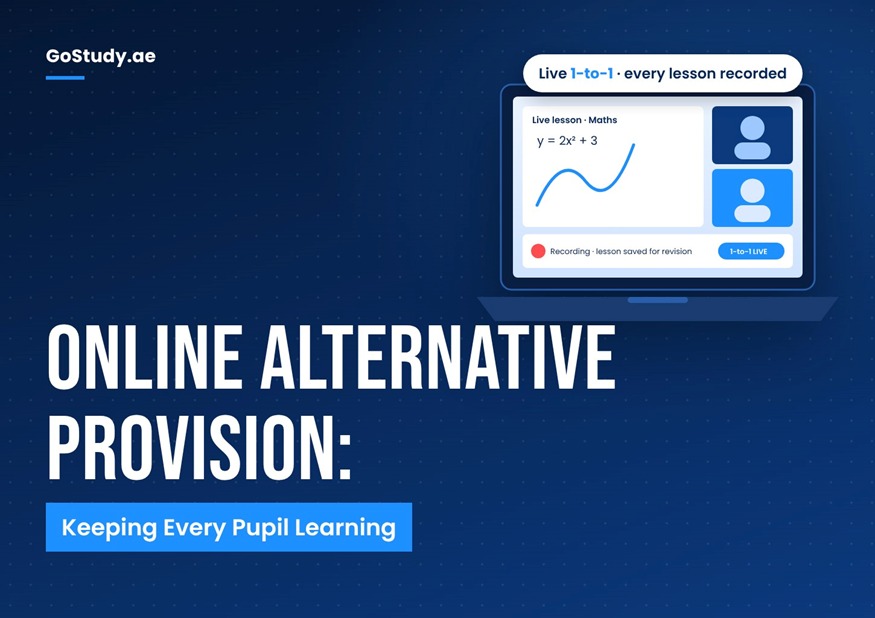
Every school has pupils who are capable of learning but cannot manage a full school day. Anxiety, illness, a long absence, an exclusion or a placement that has broken down can leave a child at home with little or no teaching, sometimes for months. Each week out of education makes the return harder.
Online alternative provision (AP) is fast becoming part of the answer. Live, teacher-led lessons delivered online let pupils keep learning while schools and families work out the longer-term plan, without waiting for a local place or a specialist to become free.
This article explains why demand is growing, what online provision makes possible, what schools should check before choosing a provider, and how GoStudy.ae’s live 1-to-1 model supports schools and families in the UK and the UAE.
• Demand for alternative provision is high: 28,300 school-arranged placements were open in England in January 2026, and three in four of those pupils have special educational needs.
• Live online teaching lets pupils keep learning from home while schools plan the next step, without waiting for a local place.
• One-to-one tuition is one of the best-evidenced ways to accelerate progress, adding an average of five months over a year.
• The best online provision is live, checked, recorded and closely linked to the pupil’s school, with a clear plan to return.
In England, Department for Education figures for 2025-26, reported by Schools Week, show 28,300 school-arranged AP placements open in January 2026. Around half were off-site placements for behavioural support. Many of these pupils also have additional needs: 37.4% had an Education, Health and Care Plan and a further 37.5% were receiving SEN support.
Even these figures understate the need. They do not include every pupil who is out of school for medical reasons, anxiety-related absence or a gap between placements.
The UAE faces a similar challenge from a different starting point. Inclusion is now firmly in policy: Federal Law No. 29 of 2006 guarantees people of determination equal access to education, and Dubai’s Inclusive Education Policy Framework (2017) expects private schools to meet a wide range of needs. Schools must deliver on that promise with limited specialist staff.
Value: 28,300
Source: DfE, via Schools Week
Value: 37.4%
Source: DfE, via Schools Week
Value: 37.5%
Source: DfE, via Schools Week
Value: +5 months’ additional progress
Source: Education Endowment Foundation
Value: USD 531.9 million
Source: IMARC Group
• Staffing: An inclusion room may hold pupils of different ages, needs and subjects with a single adult to support them.
• Subject range: Smaller AP settings can be strong on re-engagement, but may not offer the full range of GCSE or IGCSE subjects a pupil needs.
• Specialist shortages: Educational psychologists, speech and language therapists and SEN specialists are scarce, with long waiting lists in many areas.
• Time pressure: After a permanent exclusion in England, suitable full-time education must be in place from the sixth school day, and a local place is not always available in time.
• Lost momentum: A pupil who stops studying a GCSE subject for a term can fall too far behind to sit the exam.
1. Teaching without the school building: Pupils who cannot yet manage the classroom can still attend live lessons from home.
2. Specialists from anywhere: Schools can draw on subject experts and experienced teachers who are not available locally.
3. A bridge back to school: A pupil can learn online while keeping links with their school, then move gradually back into classes.
4. Speed and flexibility: Support can start within days and scale up or down for short, medium or long-term needs.
5. Qualifications kept on track: Pupils keep working towards GCSEs, IGCSEs and A-Levels instead of losing months of study.
6. A clear record: Recorded lessons and session reports show schools exactly what was taught and how the pupil engaged.
The evidence for individual teaching is strong. The Education Endowment Foundation’s Teaching and Learning Toolkit finds that one-to-one tuition adds an average of five months’ additional progress over a year. Live online delivery brings that model to pupils who cannot be in a classroom.
Online provision is not one-size-fits-all. It works best when the support is shaped around the reason the pupil is out of class.
What online support can look like: Short live lessons at home with one consistent tutor, building up slowly
Typical goal: Rebuild confidence and routine, then a phased return
What online support can look like: Flexible lessons around treatment and rest, recorded for catch-up
Typical goal: Keep up with core subjects and exam courses
What online support can look like: Fast-start teaching in core and exam subjects while the next placement is arranged
Typical goal: No gap in education, stay on track for qualifications
What online support can look like: Individual teaching matched to the pupil’s needs in the meantime
Typical goal: Keep learning while the right setting is found
What online support can look like: Teaching that follows the right curriculum and exam board
Typical goal: A smooth transfer with no lost months
What online support can look like: Specialist teaching in subjects the school cannot timetable
Typical goal: Access to subjects and levels not offered on site
When a pupil learns online, the school usually keeps responsibility for their welfare and education. Good practice is simple, but it must be agreed in writing before lessons start:
• A named lead on both sides: The school’s designated safeguarding lead and the provider’s safeguarding lead know each other and agree how concerns are shared, the same day.
• Clear attendance recording: Agree how online sessions will be recorded in the school’s register, and how quickly the school hears about a missed lesson.
• Safe online conduct: Lessons run on the provider’s platform, not personal accounts, and are recorded so that every session can be reviewed.
• Regular review: Progress, engagement and wellbeing are reviewed at set points, with the pupil and family involved.
Many pupils in alternative provision have special educational needs. Online lessons can be adapted in ways that are hard to achieve in a busy classroom:
• Predictable structure: The same tutor, the same time and the same lesson pattern each week reduce anxiety.
• Shorter, focused blocks: Lessons can be broken into shorter tasks with planned pauses.
• Visual support: The interactive whiteboard makes it easy to show worked examples, diagrams and step-by-step methods.
• A gentle start: Some pupils begin with camera off or with a parent nearby, and build up as trust grows.
• Pace set by the pupil: A 1-to-1 tutor can slow down, revisit or move ahead without holding anyone else back.
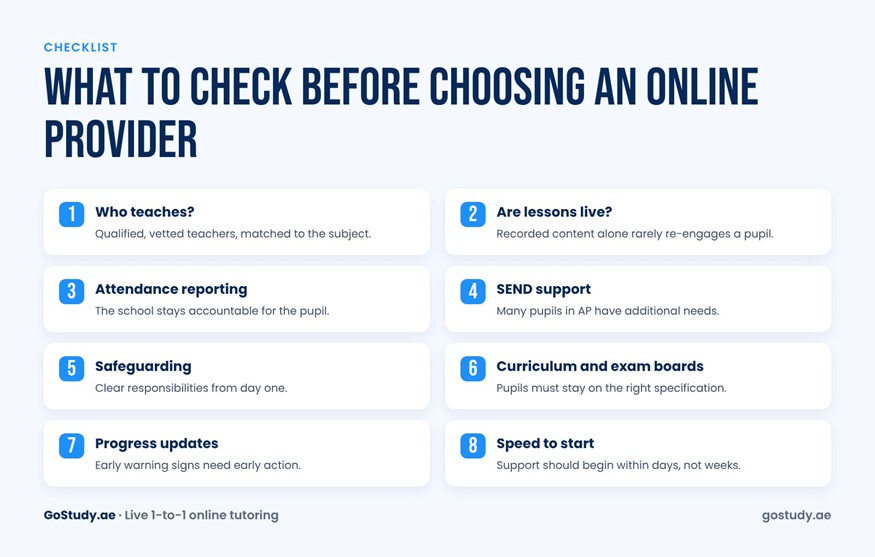
Checklist of 8 questions schools should ask an online alternative provision provider
Online provision only works if the teaching is good and the safeguards are clear. Before commissioning any provider, ask:
Why it matters: Disrupted pupils need experienced, checked teachers, not whoever is free
Why it matters: Recorded content alone rarely re-engages a pupil who has lost confidence
Why it matters: Schools remain accountable for the pupil’s education
Why it matters: Many pupils in AP have additional needs
Why it matters: Responsibilities must be clear on day one
Why it matters: Pupils must stay on the right specification
Why it matters: Early warning signs need early action
In England, the Department for Education runs an accreditation scheme for online education providers, with standards for education and safeguarding and inspection by Ofsted. Accreditation is a useful starting point, but schools should still look closely at the teaching itself.
GoStudy.ae is an online tutoring platform built around one idea: every student deserves excellent, individual teaching at the moment they need it most. We are not a replacement for school. We help schools and families keep a pupil learning when a full school day is not possible, and support the return to class.
Every GoStudy lesson is live and 1-to-1 with a qualified tutor on our interactive online whiteboard, with screen sharing and worked examples. Nothing is pre-recorded, and the tutor adapts to how the pupil responds in the moment.
Tutors pass qualification checks, background checks and a teaching demonstration before they teach. Pupils are matched to a tutor for their subject, level and exam board, from primary English and maths to GCSE, IGCSE and A-Level sciences.
All sessions are recorded, so pupils can revisit explanations and schools have a full record of the teaching delivered. After each lesson, parents receive tutor-written feedback and AI-generated insights on a real-time dashboard covering attendance, topics covered, understanding and next steps, and schools receive feedback too.
GoStudy supports additional needs, homeschooling and school admissions as well as mainstream subjects. Our work is guided by an advisory board of experienced UK education leaders, including headteachers, a school improvement and attendance consultant and a chartered psychologist.
Most pupils begin within 24 to 48 hours of registering, often with a tutor matched the same day.
• Wait for a local place or specialist
With GoStudy.ae: Tutor matched, often the same day
• One adult for a mixed group
With GoStudy.ae: Live 1-to-1 teaching
• Limited subject range
With GoStudy.ae: Specialist tutors across GCSE, IGCSE and A-Level
• Little record of what was taught
With GoStudy.ae: Every lesson recorded, with feedback after each session
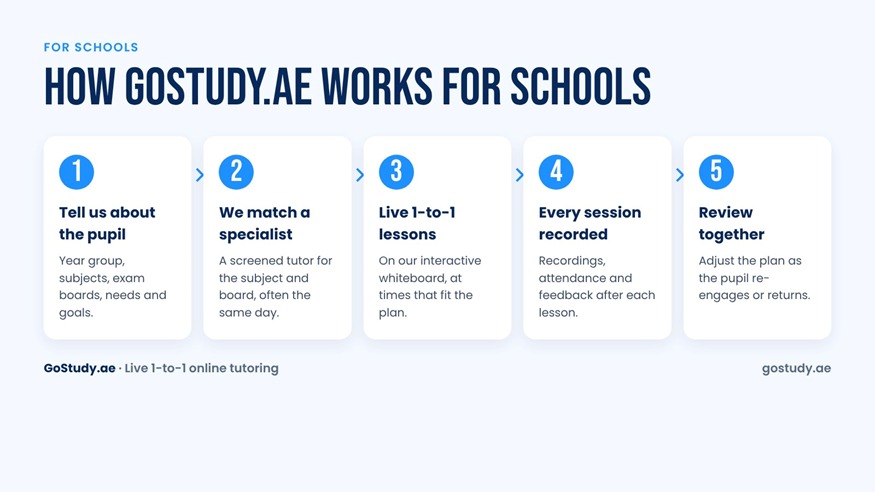
How GoStudy.ae works for schools in 5 steps
1. Tell us about the pupil: year group, subjects, exam boards, needs and goals.
2. We match a specialist tutor, often the same day.
3. Lessons start, live and 1-to-1, at times that suit the pupil and the school’s plan.
4. You get a record of every session, with recordings, attendance and progress feedback.
5. Review together and adjust the plan as the pupil re-engages or prepares to return.
Online provision works best as a bridge, not a destination. The plan below is an illustrative example of how a school might use GoStudy.ae to support a Year 10 pupil with anxiety back into class. Every plan is agreed with the school and family and adjusted to the pupil.
What happens: Two to three short live lessons a week in maths and English, one consistent tutor
What the school sees: Attendance at each session and tutor feedback
What happens: Full timetable of core and exam subjects online, longer lessons, homework set
What the school sees: Progress against the exam specification
What happens: Online lessons continue while the pupil spends part of the week in school
What the school sees: Joint review with the pupil, family and school
What happens: Pupil back in class, with online sessions kept for one or two subjects if needed
What the school sees: Catch-up gaps closed, exam courses on track
Schools should agree success measures at the start, so that everyone knows what good looks like:
How to track it: Session attendance reports after every lesson
How to track it: Tutor notes on participation and work completed
How to track it: Topic coverage and assessment results against the specification
How to track it: Check-ins with the pupil and family at each review
How to track it: Time taken to move back into classes, and whether the return holds
Yes, when they are part of a planned package of provision agreed by the school. The school should record how sessions are logged and keep oversight of the pupil’s progress and welfare.
With GoStudy.ae, most pupils begin within 24 to 48 hours of registering, and a tutor is often matched the same day.
Yes. Share the scheme of work, exam board and topics, and the tutor will teach to them so the pupil stays in step with their class.
Every lesson is recorded, and schools receive feedback after each session, so you have a full record of the teaching delivered.
Yes. GoStudy.ae is based in Abu Dhabi and teaches students in the UAE, the UK and internationally, across British, IB, American, Indian and UAE curricula.
➣ Alternative provision (AP)
Meaning: Education arranged for pupils who cannot attend mainstream school, for example because of exclusion, illness or other reasons
➣ EHCP
Meaning: Education, Health and Care Plan: a legal document in England setting out a child’s special educational needs and the support they must receive
➣ SEN support
Meaning: Extra help in school for pupils with special educational needs who do not have an EHCP
➣ SENCo
Meaning: Special educational needs coordinator, the teacher who leads SEN support in a school
➣ DSL
Meaning: Designated safeguarding lead, the person responsible for child protection in a school
➣ People of determination
Meaning: The UAE term for people with disabilities or additional needs
Online provision is moving from an emergency fix to a recognised part of how schools support pupils who cannot attend full-time. In the UAE, the online education market is growing quickly, estimated by IMARC Group at USD 531.9 million in 2025 and forecast to reach about USD 3.5 billion by 2034. Used well, with live teaching, clear oversight and close links to the pupil’s school, online provision keeps every pupil learning, connected and on track.
Whether you are a school leader, inclusion lead or parent, we can help you put the right support in place quickly.
Chat with us on WhatsApp · Register in 2 minutes · Call +971 58 559 3327
• Schools Week, 19 October 2026: “An alternative to the alternative: the possibilities that online AP opens for schools”, reporting Department for Education AP figures
• Education Endowment Foundation: One to one tuition (Teaching and Learning Toolkit)
• GOV.UK: How the online education accreditation scheme works
• UAE Government portal: Education for people of determination
• Education Middle East: Dubai Inclusive Education Policy Framework
• IMARC Group: UAE online education market
Written by the GoStudy.ae academic team.