

GoStudy
Author
Nov 4, 2026
Published
8 mins read
Read Time
By the GoStudy.ae academic team · Updated 4 November 2026
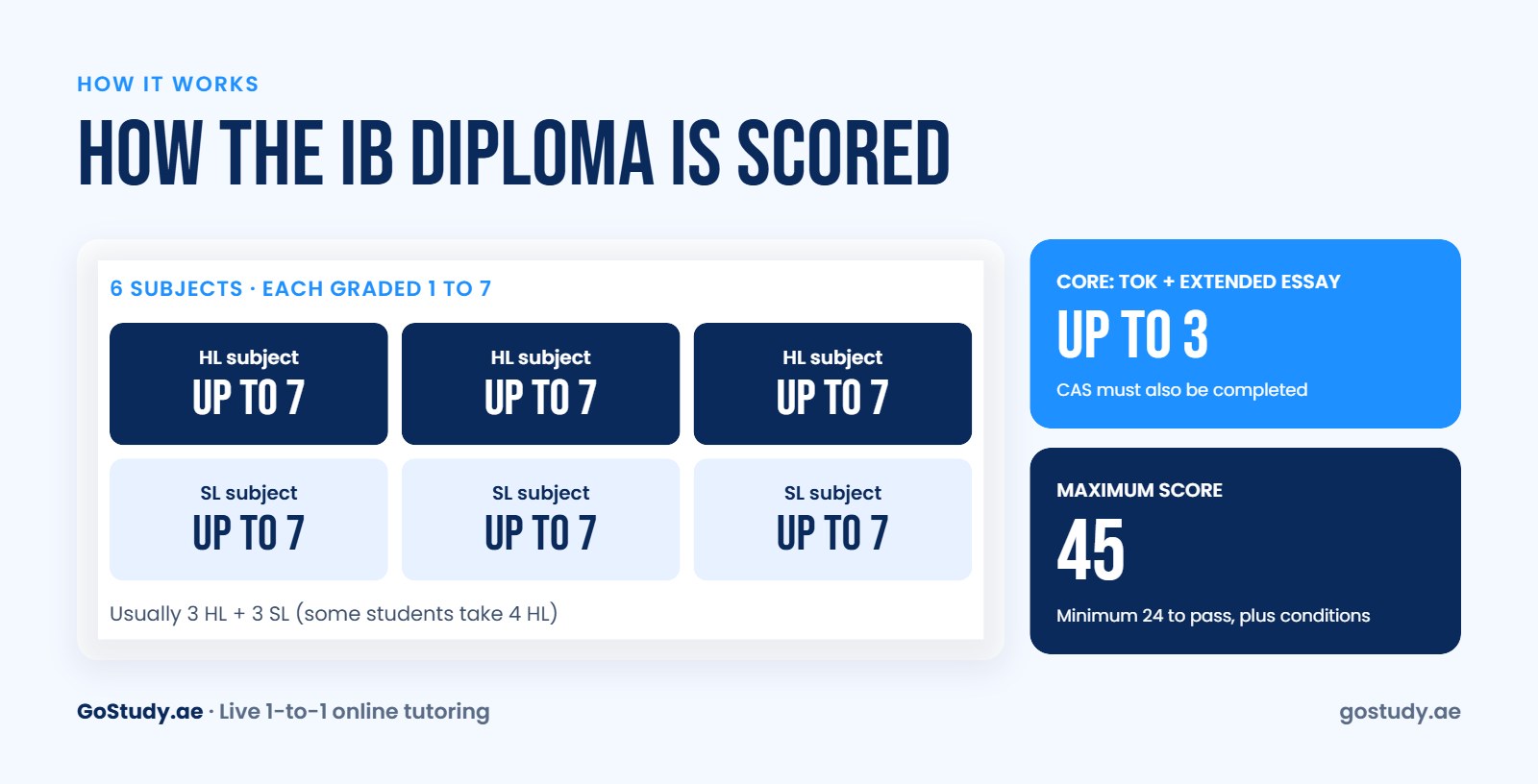
Quick answer: The IB Diploma is scored out of 45: six subjects graded 1 to 7, plus up to 3 points from Theory of Knowledge (TOK) and the Extended Essay (EE). You need at least 24 points and must complete CAS. For the May 2027 exams, use the next six months in this order: finish the Extended Essay and plan internal assessments (November), submit strong IA drafts (December), sit and review mocks (January), complete TOK and fix weak Higher Level topics (February), do full past papers (March) and polish (April).
If your child is in IB Diploma Year 2 in Abu Dhabi, Dubai or anywhere in the UAE, the final exams start in about six months. But in the IB, a large part of the final grade is decided before the exams even begin, through coursework, the Extended Essay and TOK.
This guide explains how the IB Diploma is scored, the key dates for May 2027, a month-by-month plan, subject-by-subject advice and when an IB tutor makes a real difference.
| What | When | Notes |
|---|---|---|
| Internal deadlines for IAs, EE and TOK | November 2026 to March 2027 | Set by each school; ask your IB coordinator |
| School mock exams | Usually January or February 2027 | Dates set by each school |
| May 2027 exam session | From Monday 26 April 2027, running into May | Schedules published by IB schools; your coordinator confirms each paper |
| Results | Usually early July 2027 | May 2026 results were released to students on 6 July 2026 |
| Part | How it is graded | Points |
|---|---|---|
| Six subjects (usually 3 Higher Level and 3 Standard Level) | Each graded 1 to 7 | Up to 42 |
| Theory of Knowledge and Extended Essay | Each graded A to E, combined on a matrix | Up to 3 |
| CAS (creativity, activity, service) | Must be completed; not graded | 0 |
| Total | Up to 45 |
To be awarded the diploma, students need at least 24 points and must also meet other conditions set by the IB. For example: no subject below grade 2, completed CAS, at least 12 points across Higher Level subjects and at least 9 across Standard Level subjects (when taking three of each), and no failing grade combination in TOK and the Extended Essay.
| Score | What it usually means |
|---|---|
| 24 to 29 | Diploma awarded; meets many university entry requirements |
| 30 to 33 | Solid score for a wide range of universities |
| 34 to 38 | Competitive for many leading universities in the UK, Europe and beyond |
| 39 and above | Excellent; competitive for the most selective courses |
University offers often specify grades in particular Higher Level subjects too, such as a 6 or 7 in HL Mathematics for engineering. Always check the exact offer for each course.
In most IB subjects, internal assessment (IA) coursework counts for a significant share of the final grade, commonly around 20 to 30%, and more in some arts subjects. The Extended Essay and TOK decide up to 3 of the 45 points. Most of this work is due to your school between November and March.
That means strong students can lose points not because of the exams, but because an IA was rushed or an Extended Essay question was too broad. The next six months are about securing coursework marks first, then building exam performance.
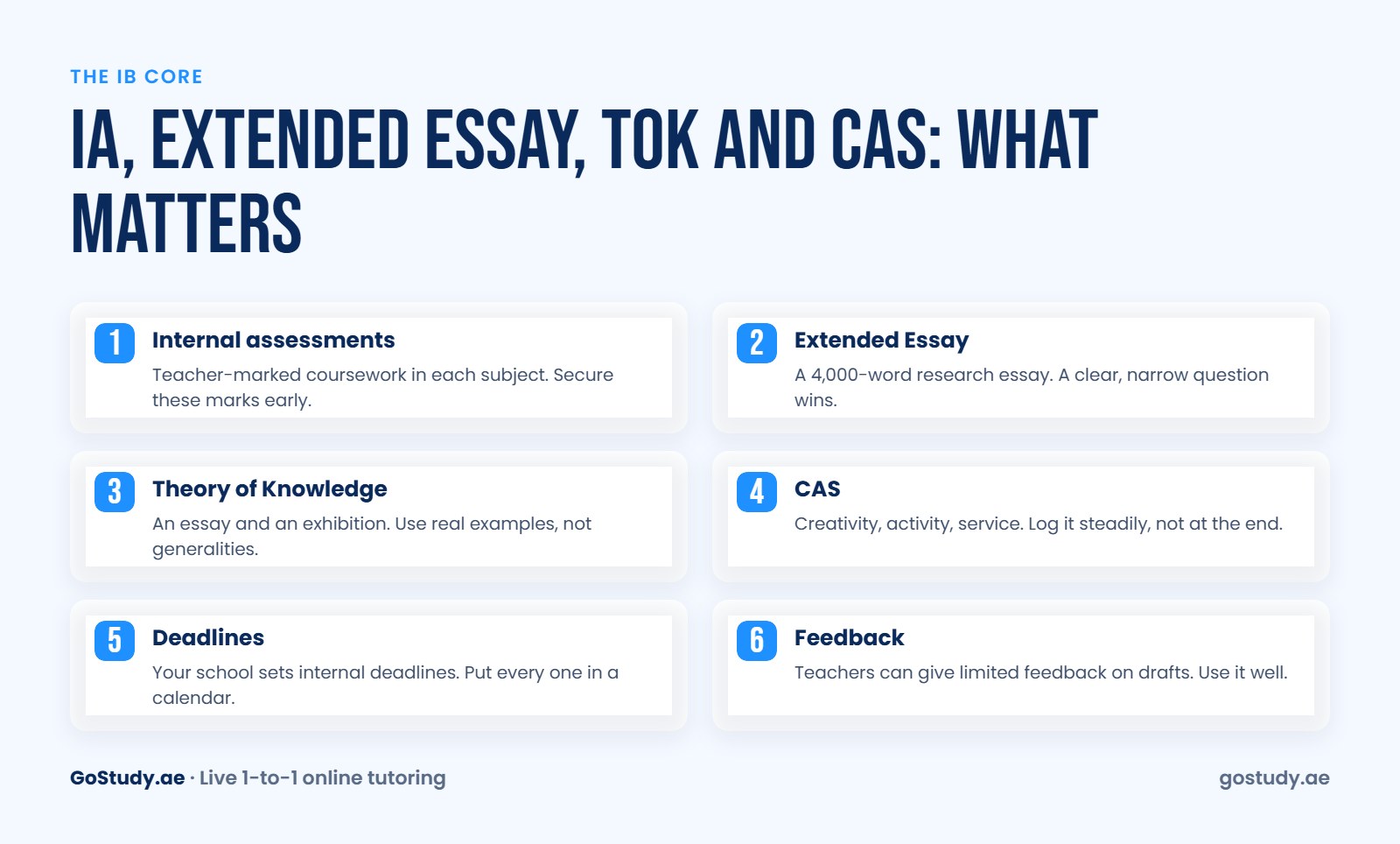
Each subject has its own IA, marked by your teacher against published criteria and checked by the IB. To score well:
The EE is an independent research essay of up to 4,000 words, supervised by a teacher. The most common reason for a low grade is a research question that is too broad to answer properly. Pick a question you can genuinely investigate, keep your reflections up to date, and leave time for a full rewrite.
TOK is assessed through an essay on a prescribed title and an exhibition. The strongest TOK work uses specific, real examples and weighs different perspectives, rather than making general statements. Start the essay early: it improves with every redraft.
CAS is not graded, but without it there is no diploma. Log experiences and reflections steadily through the year instead of trying to catch up in the spring.
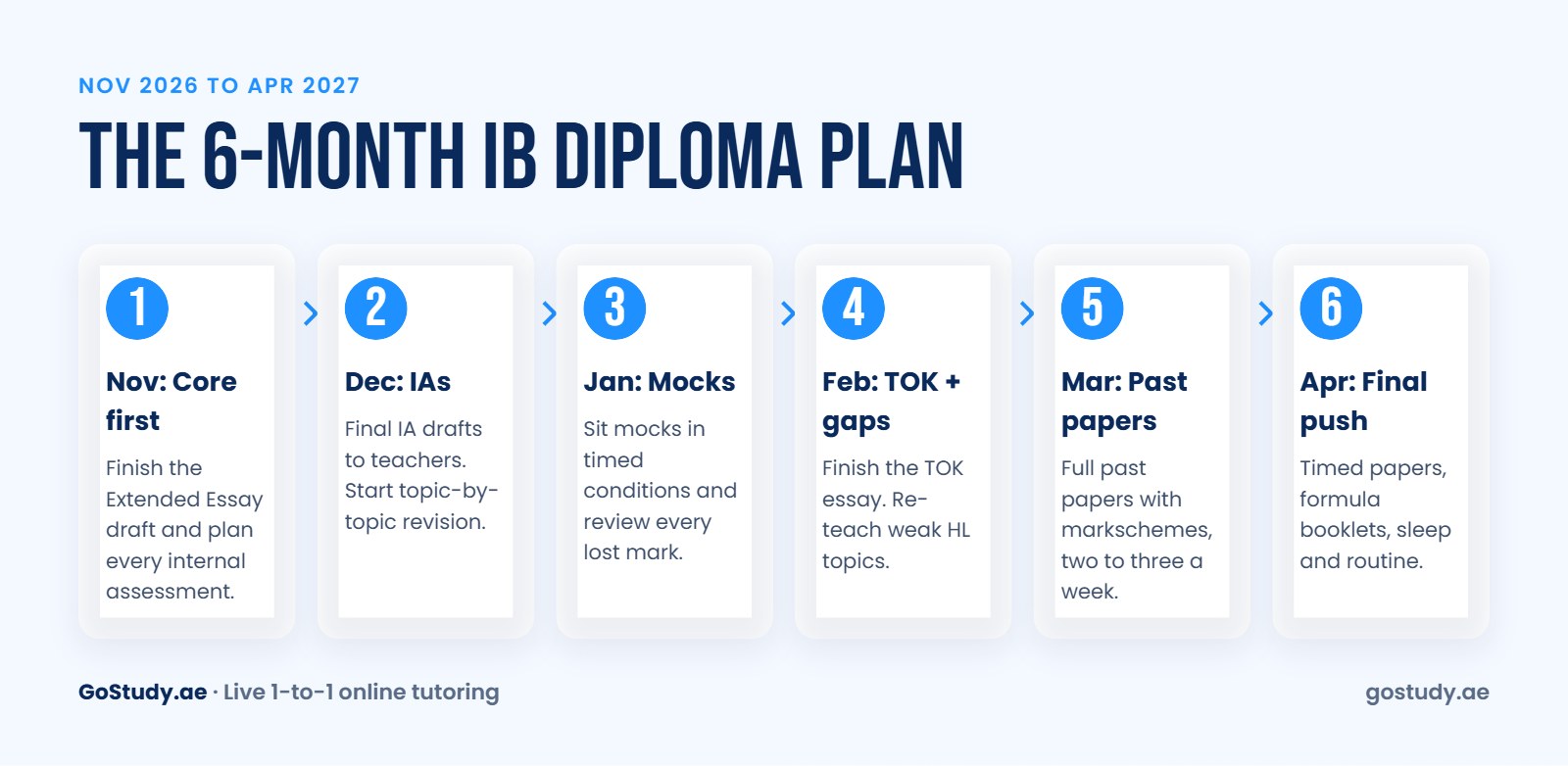
Finish a full draft of the Extended Essay. List every IA with its school deadline and make a plan for each one. Make sure your CAS record is up to date.
Submit complete, polished IA drafts to your teachers. Use the winter break to start topic-by-topic revision, beginning with your weakest Higher Level subject.
Sit mock exams in timed conditions. Afterwards, go through every lost mark: was it a knowledge gap, a misread command term, poor timing or a careless error? Each needs a different fix.
Finalise the TOK essay. Re-learn the topics your mocks exposed. Ramadan is expected to fall in February and early March 2027, so plan shorter, more frequent study sessions during that time.
Work through full past papers with the official markschemes, two to three a week across subjects. Learn the IB command terms (“explain”, “evaluate”, “discuss”) and what each one requires.
Timed papers, formula booklets and summary sheets. Keep a fixed routine and protect sleep. The exams start in late April, so the Easter break is your last big revision block.
| Period | School days | Weekends and holidays |
|---|---|---|
| November to December | 2 to 3 hours, mostly IA and EE work | 3 to 4 hours |
| January to February | 2 to 3 hours, mocks and TOK | 4 hours |
| March to April | 3 hours of past papers and revision | 5 hours, with breaks |
| Exam session | Focus on the next paper | Rest between exams |
Study in focused blocks of 45 to 60 minutes. Testing yourself with past-paper questions is far more effective than re-reading notes.
| Subject group | Focus on |
|---|---|
| Group 1: Language A (English, Arabic and others) | Close analysis with precise evidence; timed Paper 1 practice on unseen texts |
| Group 2: Language acquisition | Daily reading and listening; practise every text type for the writing paper |
| Group 3: Individuals and societies (Economics, History, Business, Psychology) | Clear definitions, diagrams where needed, real examples and balanced evaluation |
| Group 4: Sciences (Biology, Chemistry, Physics) | Data analysis questions, calculations, and the language of the markscheme |
| Group 5: Mathematics (Analysis and Approaches, Applications and Interpretation) | Daily practice, every topic, calculator skills and full working for method marks |
| Group 6: The arts | Process portfolio and exhibition work on schedule, with regular teacher feedback |
Higher Level subjects carry the most content and usually the toughest university requirements. Most students should:
An IB tutor makes the biggest difference when:
Note that the IB has strict rules on academic integrity: coursework must be the student’s own work. A good tutor teaches the skills and explains the criteria, and never writes the coursework for the student.
The evidence supports targeted individual help. The Education Endowment Foundation’s Teaching and Learning Toolkit finds that one-to-one tuition adds an average of five months’ additional progress.
GoStudy.ae is an online tutoring platform based in Masdar City, Abu Dhabi, chosen by more than 2,000 students. We teach all three IB programmes: PYP, MYP and the Diploma Programme.
| What you get | Why it matters for the IB |
|---|---|
| Live 1-to-1 lessons on an interactive whiteboard | Time spent on your child’s weakest topics and HL subjects |
| Tutors matched to subject and level (HL or SL) | Teaching follows the current IB subject guide |
| Help with skills for IAs, EE and TOK | Understand the criteria and plan strong work, within IB academic integrity rules |
| Every lesson recorded | Rewatch explanations before mocks and exams |
| Parent dashboard with feedback after each lesson | See topics covered, understanding and progress |
| Start within 24 to 48 hours | Help arrives before coursework deadlines |
Getting started:
Students take six subjects, each graded 1 to 7, and earn up to 3 more points from Theory of Knowledge and the Extended Essay. The maximum is 45 points. The diploma needs at least 24 points plus other conditions, including completing CAS.
IB school schedules show the May 2027 session starting on Monday 26 April 2027 and running into May. Your school’s IB coordinator confirms each paper’s date.
May session results are usually released in early July. May 2026 results were released to students on 6 July 2026.
24 is the minimum to pass. Many competitive universities ask for 34 to 38 or more, often with specific grades in Higher Level subjects. Check the exact offer for each course.
Yes, within the IB’s academic integrity rules. A tutor can teach research and writing skills, explain the assessment criteria and help a student plan, but the work itself must be the student’s own.
For most students, yes. Live online lessons give full 1-to-1 attention, with recorded lessons for revision, no travel time and access to specialist IB tutors anywhere in the UAE.
Yes. Our tutors also cover IGCSE, GCSE and A-Level, and we have a separate IGCSE revision plan for the May/June 2027 exams.
Pay-as-you-go 1-to-1 lessons are priced by school year, up to 550 AED per hour for Year 13, and block bookings save up to 15% per session. See our pricing page.
The points that decide university offers are being won and lost right now, in coursework and in the first mock exams. Tell us your subjects, levels and target score, and we will match the right IB tutor.
Chat with us on WhatsApp · Register in 2 minutes · Call +971 58 534 1673
Written by the GoStudy.ae academic team.